International Support
2026 Australia and New Zealand mobilization
In July and August 2026, Australia and New Zealand sent personnel to assist the United States with wildfire suppression. The National Multi-Agency Coordinating Group, located at the National Interagency Fire Center in Boise, Idaho, requested the international assistance. The first group to arrive included 74 fire management specialists, including a 15-person Incident Management Team. The team integrated with U.S. personnel to support command and control, planning, logistics, operations, and safety oversight. After 30 days on firelines, including the Castle Fire on Umpqua National Forest, this first group headed home on August 27.
The second wave of international wildfire personnel from Australia and New Zealand brought 240 additional fire management specialists. They arrived in the U.S. on August 11 and 12. After several days of orientation, national situation briefings and training, these specialists were assigned to work across the Northwest and Great Basin geographic areas in support of wildfire response. After providing support to numerous incidents, this group departed for home in the second week of September.
Check out 2026 photos at: 2026 International Support | Flickr
2025 U.S. to Canada mobilization
In June 2025, the National Interagency Coordination Center mobilized federal firefighting personnel to support wildfire suppression efforts in Canada (Manitoba, Saskatchewan, British Columbia, and Alberta). This cross-border support is made possible through a long-standing agreement between the United States and Canada, first established in 1982. This crucial partnership is rooted in shared landscapes, common challenges, and a mutual commitment to protecting lives, property, and natural resources.
Resources that were mobilized to Canada include airtankers, firefighting crews, complex incident management teams (CIMTs), and overhead staff.
Check out the 2025 photos at: NIFC Flickr 2025 Canada Support.
2025 Canada to U.S. mobilization
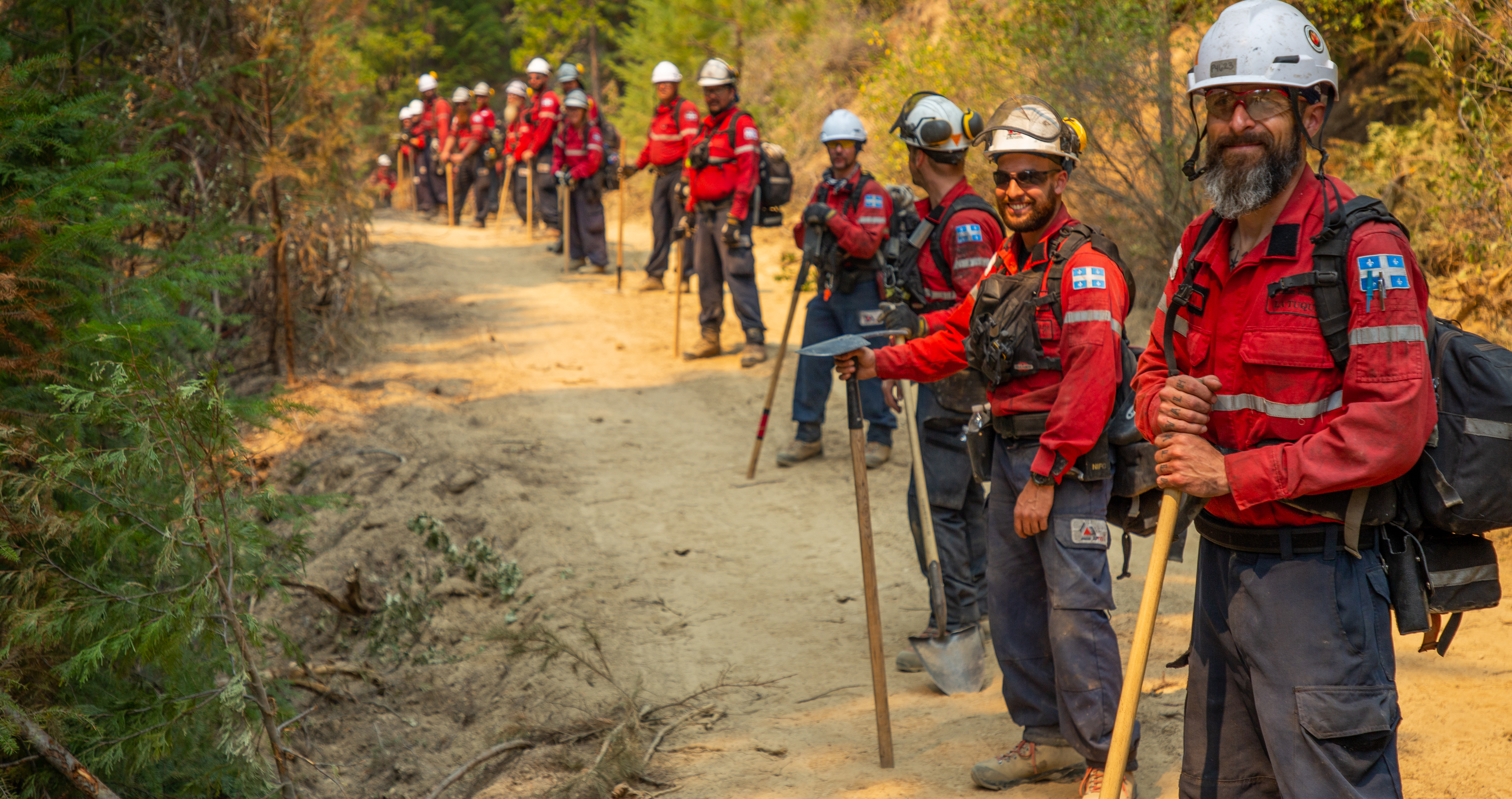
In January 2025, Canadian resources supported suppression efforts in Southern California with two airtankers from Quebec, two crews and two overhead personnel from Alberta, and one crew and one overhead personnel from British Columbia.
2024 Australia and New Zealand mobilization
A group of 71 fire management personnel from Australia and New Zealand arrived in the U.S. on August 7, 2024 to assist with management of numerous wildfires across the West. The personnel arrived at the National Interagency Fire Center.
The two contingents received a daylong orientation and situation briefing and equipment for their assignments. They assisted with various wildfires in the Pacific Northwest. The personnel are primarily fire managers that provided safety and fireline supervision consistent with U.S. wildland fire standards.
The Australian and New Zealand firefighters finished their assignments, and the final group departed for their home countries the week of September 9. We are deeply grateful for their support.
Mutual wildland fire support between the countries goes back several decades. In recent years, the U.S. sent several hundred personnel to Australia to help with a series of devastating wildfires from December of 2019 to April of 2020. In 2023, the U.S. sent 2,774 wildland firefighters to Canada during a historic fire season across multiple provinces.
Check out the 2024 photos at: NIFC Flickr 2024 Australia and New Zealand Support
2023 U.S. to Canada support
In 2023, Canada experienced an unprecedented wildfire season with 6,623 reported wildfires burning over 45 million acres—well beyond the 10-year average of 5,597 fires for 6,798,267 acres. Starting in April, the wildfire activity escalated across all provinces and territories, leading to a National Preparedness Level of PL5 on May 11, which remained until dropping to PL4 on September 8. The United States was one of 12 countries that mobilized wildland fire personnel to Canada. Through the NIFC-CIFFC Agreement the U.S. provided resource support from May through early October to Alberta, British Columbia, Ontario, and Quebec. These resource mobilizations included three smokejumper aircraft (with smokejumper personnel), two Type 2 rappel helicopters (with personnel), 29 engines, 77 hand crews and 25 incident management teams3. A total of 2,774 resources were mobilized to Canada.
Check out the NIFC Flickr 2023 Canadian Support album.
Background
The U.S. has maintained wildfire cooperation with Canada, Mexico, Australia, New Zealand, and Portugal for decades.
Australia and New Zealand
Arrangements with Australia and New Zealand set procedures for the exchange of wildland fire management resources and establishes a framework for mutual support and cooperation.
Since 1982, the U.S. and Canada have maintained an arrangement between the National Interagency Coordination Center (NICC) in the U.S. and the Canadian Interagency Forest Fire Centre (CIFFC) in Canada to ensure efficient resource sharing during peak fire activity.
We have been working together since the early 1990s beginning with coordinating firefighting personnel and resources in response to fires along the U.S.-Mexico border. A new arrangement was formalized in March 2015, to expand that cooperation across both countries (not just along the immediate border), and to include joint pre-suppression and training exercises in addition to response activities.
Portugal
We have cooperated with Portugal on specific fire management initiatives for many years, and in 2023 entered into an arrangement which will primarily be used to enable joint training and research activities, working toward the ability to exchange fire suppression resources in the future.
These bilateral interagency agreements allow reciprocal support during periods of severe wildfire occurrence when resources are fully committed and nations are in need of support from other countries to safely and effectively manage wildland fire incidents. They also allow us to exchange resources for wildfire preparedness, training, research, and post-fire recovery.


